UX Research · Product Design · Computer Science
Telekonnect
A research led product where the useful insight was not simply that social media affects mood. The design challenge was helping a person recognise patterns across app use, sleep, activity and emotion without pretending the product could diagnose their mental health.
The research problem
The project began in 2019 as an app concept centred on mood viewing and emotional pattern tracking. It aimed to bridge mental health and technology by asking how a digital product could help users understand what they felt, why they felt it and how their online behaviour connected with that emotional state. Please see the attached dissertation for the fuller research background and product development process. Rather than stopping at literature review, the project defined user centred objectives around understanding benefits and harms, why people use social media, what anxiety like behaviours are triggered and what practical interventions users would actually accept.
The research referenced a large numerical dataset of 7,129 people aged 17 to 40 alongside questionnaire and interview work. The resulting direction was not to build another social network, but to give people a way to recognise patterns between app use, mood and everyday behaviour.
The product
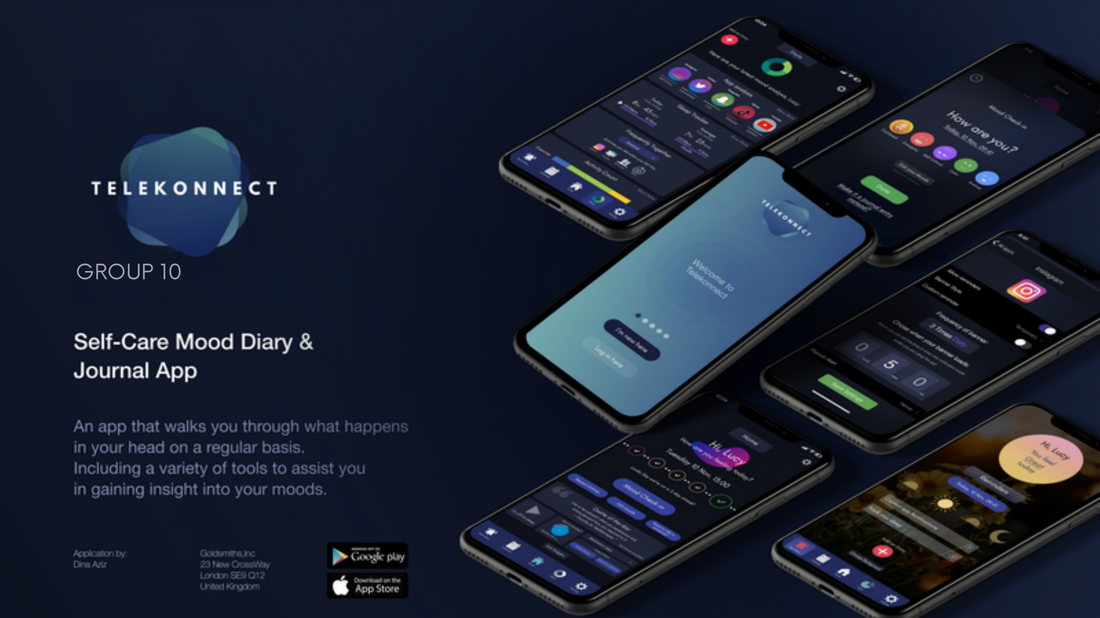
Telekonnect was designed as a calendared mood journal that connects emotional check ins with screen time and activity data. The concept includes daily, weekly, monthly and yearly analysis, sleep tracking, journal entries, app level analysis, configurable reminders, mood check ins and views that help users see which activities frequently occur alongside particular feelings.
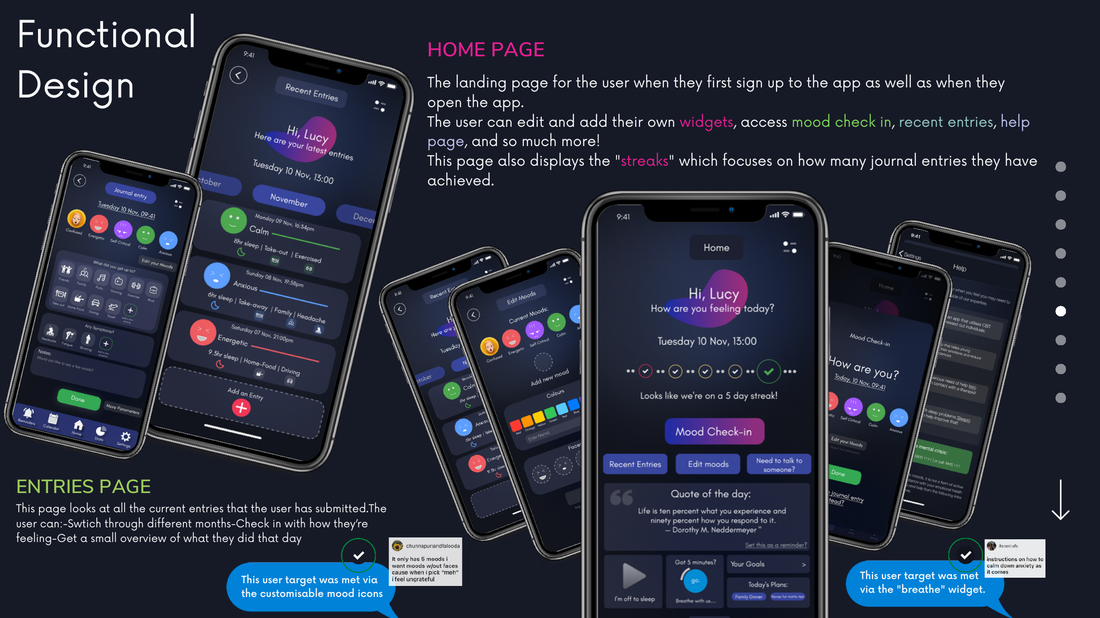
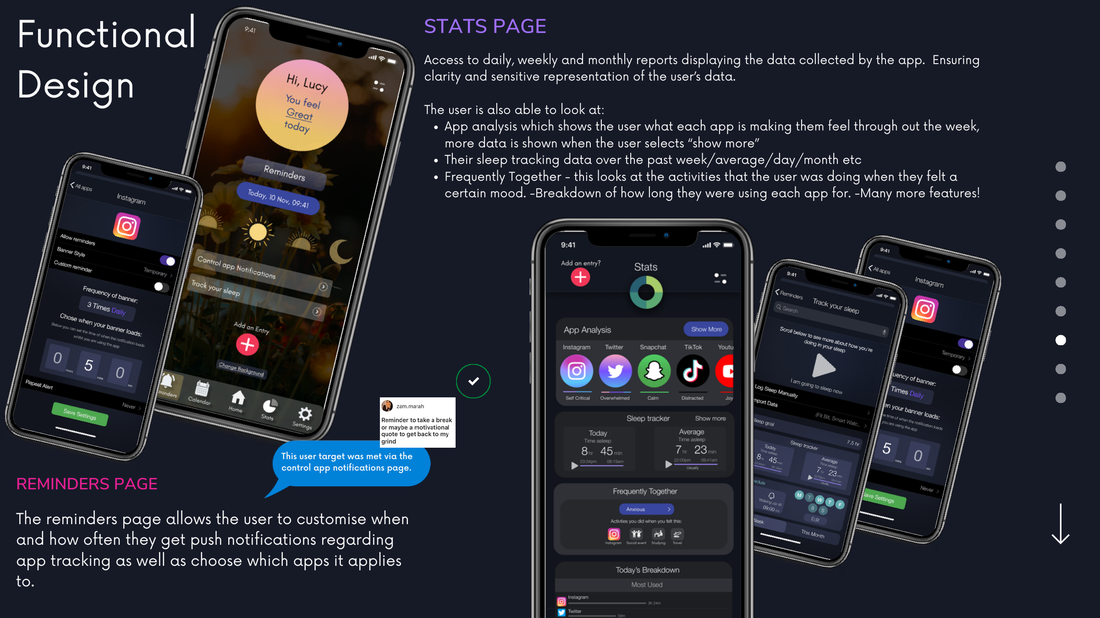
The design work progressed from low fidelity flows into a high fidelity mobile prototype. The final screens cover onboarding, a calendar view, a customisable home experience, recent journal entries, breathing support, app analysis, sleep tracking, notification controls and a statistics area intended to represent sensitive personal data clearly rather than overwhelm the user.
Research shaped the feature set
Feature decisions were tied back to user responses. The dissertation reports that 87 percent of respondents said they would benefit from sleep tracking, while more than 90 percent were interested in a daily through yearly mood analysis view. Feedback on notification prompts also highlighted a key design tension: users wanted lightweight reflection without feeling monitored or interrupted.
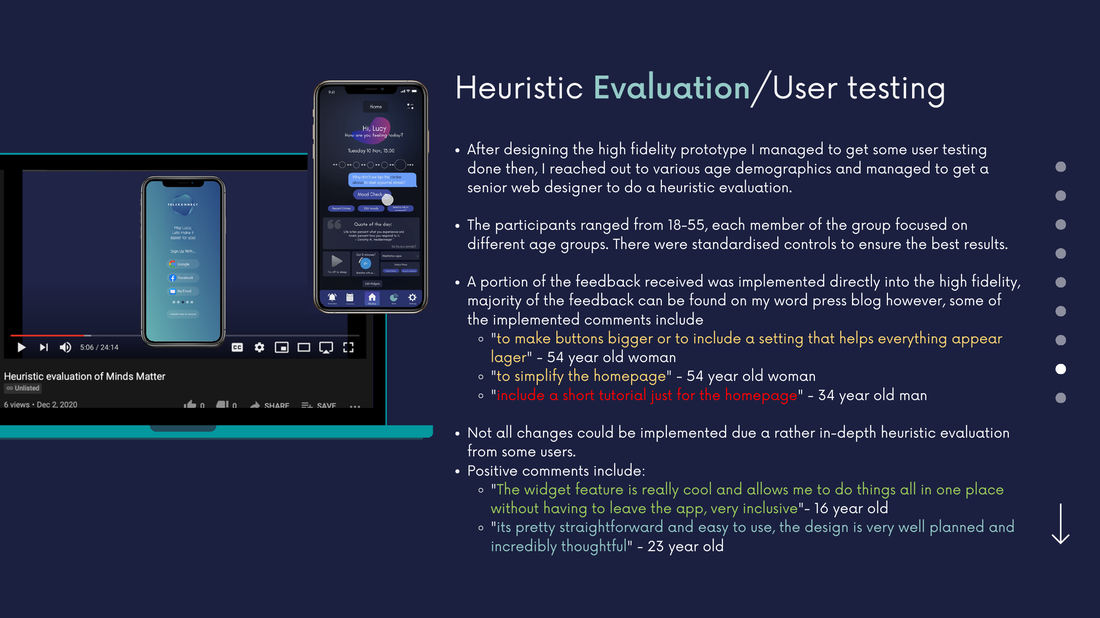
After the high fidelity prototype, user testing included participants across ages 18 to 55 and a heuristic evaluation by a senior web designer. Feedback led to practical accessibility and usability changes, including larger controls, a simpler homepage and clearer onboarding guidance.
What I would do differently now
My 2019 work tried to solve a very broad mental health problem in one product. Today I would narrow the first release substantially. I would avoid implying that screen time data can diagnose mental health, define a much clearer boundary between self reflection and clinical support, and involve mental health specialists earlier.
I would also simplify the information architecture, reduce the number of simultaneous dashboard modules, design accessibility from the first wireframe, and test the emotional impact of notifications much more rigorously. The strongest idea I would retain is the pattern viewer: helping a user reflect on relationships between behaviour and mood without presenting correlation as medical causation.
Full dissertation
The complete dissertation is available below for anyone who wants to review the full research, methodology, primary research, design process, implementation, testing and evaluation behind Telekonnect.
Download the full dissertationProduct judgement
What changed between research and interface.
The original research contained far more information than a user should ever see at once. The design task was therefore one of selection and sequencing: decide which signals belonged on the home experience, which should sit behind deeper analysis and which features would create reflection rather than anxiety.
Usability testing with people aged 18 to 55 changed controls, navigation and onboarding. That taught me an early product lesson I still use now: a feature can be logically correct and still be wrong if the user cannot understand it quickly or feels uncomfortable using it.
Outcome and what happened next
The work received a first class dissertation result. A route to continue the project with Goldsmiths funding was explored, but I chose not to take the product forward at that point. That makes Telekonnect useful to revisit now: the core problem around digital wellbeing has only become more relevant, while the original work already demonstrates research, feature prioritisation, interaction design and iterative testing.