Islamic apps can be useful yet fragmented, cluttered or overly engagement driven, which can create pressure rather than calm.
Product Design · UX Strategy · Islamic Digital Product
My Ummah
For the people, by the people. A personal Islamic companion designed for daily practice, deep learning, Ramadan preparation and reflection without turning worship into performance.
At a glance
Translated adjacent evidence from the Ramadan Planner into product principles, audience hypotheses, information architecture, risk assumptions and a 29 screen prototype.
Independent Alpha concept. The product lineage is real, but dedicated user research, scholar review, content governance and production testing are still required.
Current stage
Alpha, with trust treated as a product requirement.
I use Discovery → Alpha → Beta → Live to keep maturity honest, but I have kept the full lifecycle explainer on the Lloyds case study rather than repeating it here. My Ummah is currently Alpha: the architecture and prototype make the riskiest assumptions visible so they can be challenged before any claim of validation.
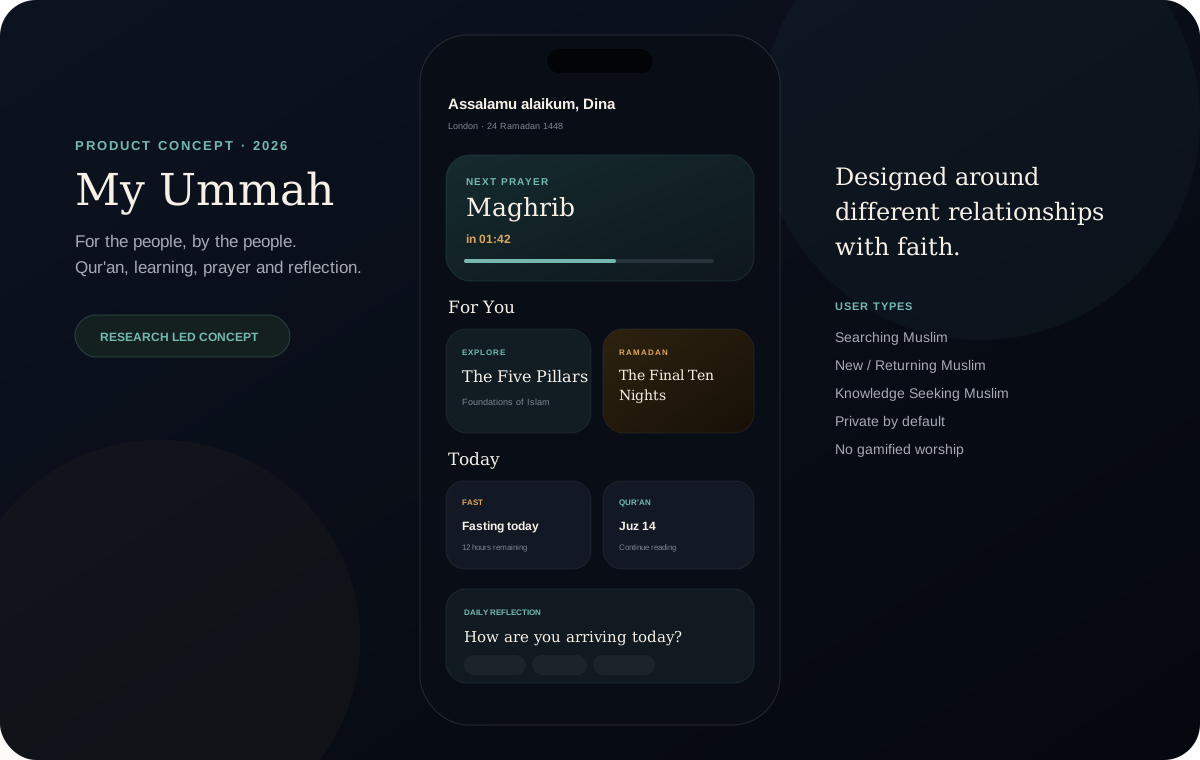
My Ummah began with a Jobs to be Done question: when I want to practise, learn or return to something in Islam, help me find a trustworthy next step without making my faith feel like a scorecard. That is deliberately broader than “put every Islamic feature in one app.”
There is a gap between utility and pressure.
My Ummah began with a simple question: what does an Islamic app look like when it is useful enough to reach for every day, but respectful enough not to turn someone's relationship with Allah into a score?
Functional, but often cold
Prayer alarms, basic Qur'an text and Qibla tools solve clear jobs, but can feel like disconnected utilities rather than a thoughtful companion.
Engagement can become pressure
Streaks, points, badges and completion metrics can make private acts of worship feel like performance data and create guilt when consistency changes.
Depth without surveillance
The concept explores a middle ground: trustworthy learning, practical tools, reflection and contextual guidance with tracking that is completely optional.
Product thesisA calm, trustworthy companion that adapts to the user's life rather than asking the user to perform for the app.
The product should reduce fragmentation without becoming another source of spiritual pressure.
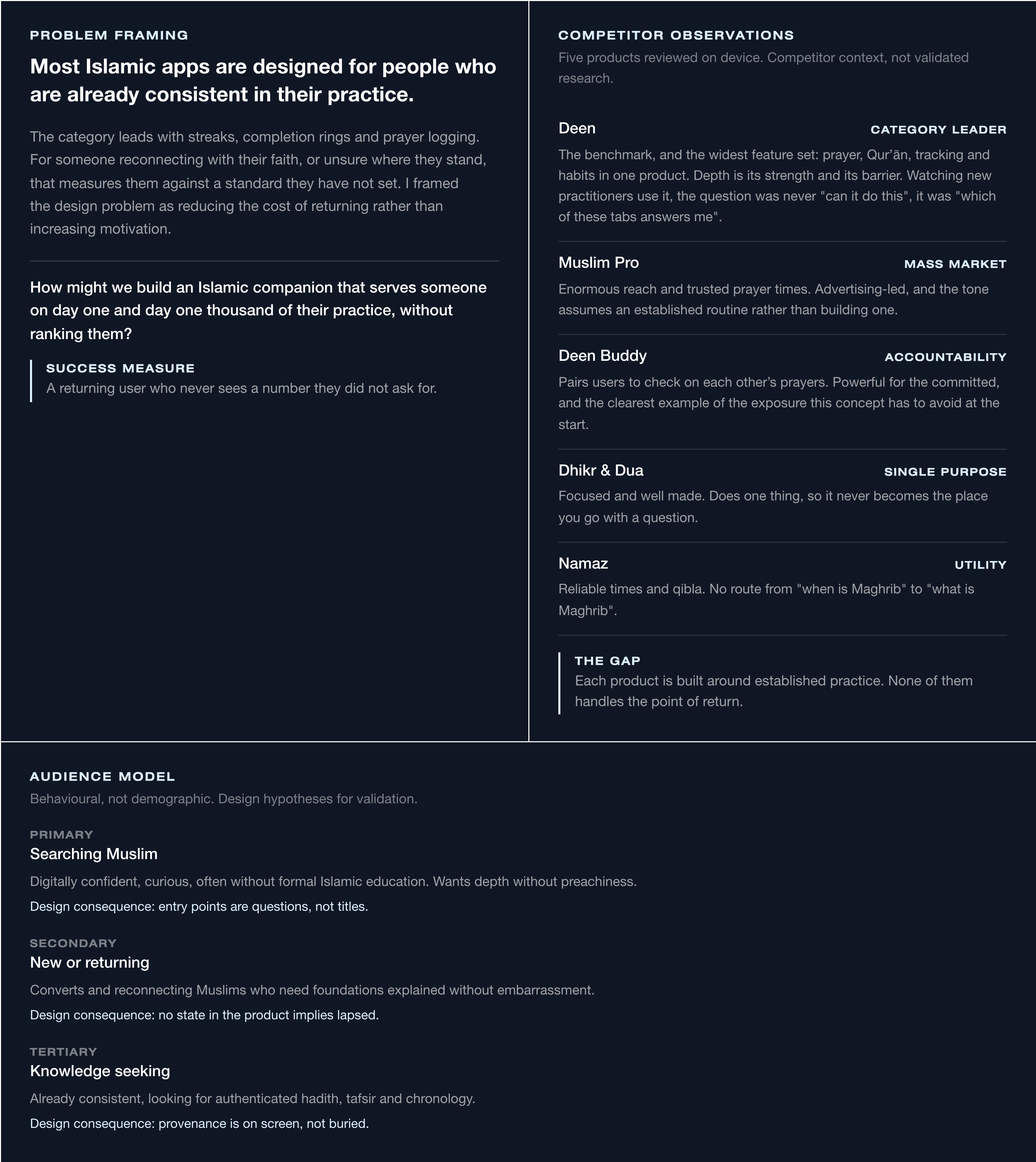
The potential user need is not “one Islamic app with everything.” It is a calm, trustworthy way to find, understand and return to guidance. Feedback and iteration from the Ramadan Planner provide adjacent evidence about reflection, structure and cognitive load. I would synthesise that with interviews, competitor patterns and content behaviour, then use assumption mapping to expose the beliefs that are still unproven, especially around personalisation, worship tracking and AI assisted guidance.
User need → problem → hypothesis → test
The Ramadan Planner provides adjacent evidence about designing for reflection, structure and lower cognitive load. The current Islamic app landscape also gives a competitor context. These are inputs into Discovery, not proof that the proposed feature ecosystem is correct.
Muslims with different levels of confidence and knowledge would value one contextual system if it preserves trust, source visibility, emotional safety and simplicity.
If the product surfaces the right tool at the right moment and keeps provenance visible, users will find useful Islamic resources more easily without feeling monitored, judged or overwhelmed.
Interview across searching, returning, new and knowledge seeking Muslims, then test concrete tasks such as finding a sourced answer, returning to a saved lecture, learning wudhu, disabling tracking and understanding the difference between Qur’an, hadith, fiqh and AI explanation.
Origin
From my Ramadan Planner to a year round system.
The starting point was my physical Ramadan Planner, which already brought together fasting, salah, Qur'an, reflection, planning and practical guidance. The digital opportunity was larger: connect the moments Muslims currently scatter across Qur'an apps, podcast platforms, browser searches, notes, saved videos and seasonal planners.
The goal is not to replace every specialist product. It is to create a useful home layer that knows what matters now, then helps the user move into deeper content when they need it.
Target audience
Designed around relationships with faith, not stereotypes.
The initial audience model is behavioural. Practice, knowledge and confidence change over time, so My Ummah is designed to meet different starting points without assuming that age or background determines religious understanding.
Building an adult relationship with Islam
Typically 22 to 40, digitally confident and curious, but may not have had formal Islamic education. Wants depth without preachiness, honest treatment of complexity and a product that feels contemporary rather than culturally narrow.
Needs foundations without embarrassment
Converts, reconnecting Muslims and people deepening practice later in life. Needs Shahadah, Five Pillars, wudhu and salah explained clearly without condescension or assumptions about prior knowledge.
Wants to go deeper
Already more consistent in practice and looking for authenticated hadith, tafsir, Qur'an chronology, comparative context and richer lecture content without reducing scholarship to a feed.
These audience definitions are design hypotheses for validation, not claimed research findings.
Discovery artefacts
I started messy on purpose.
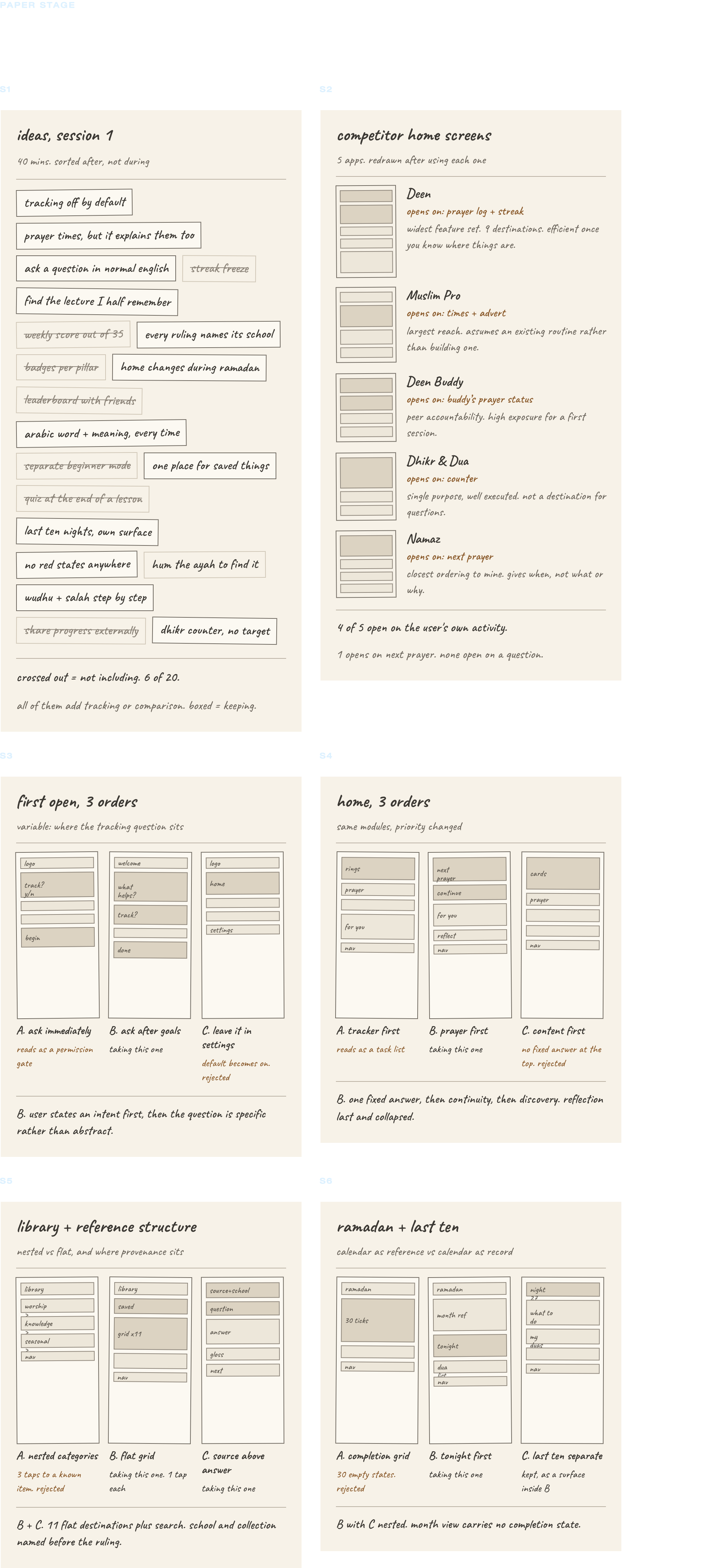
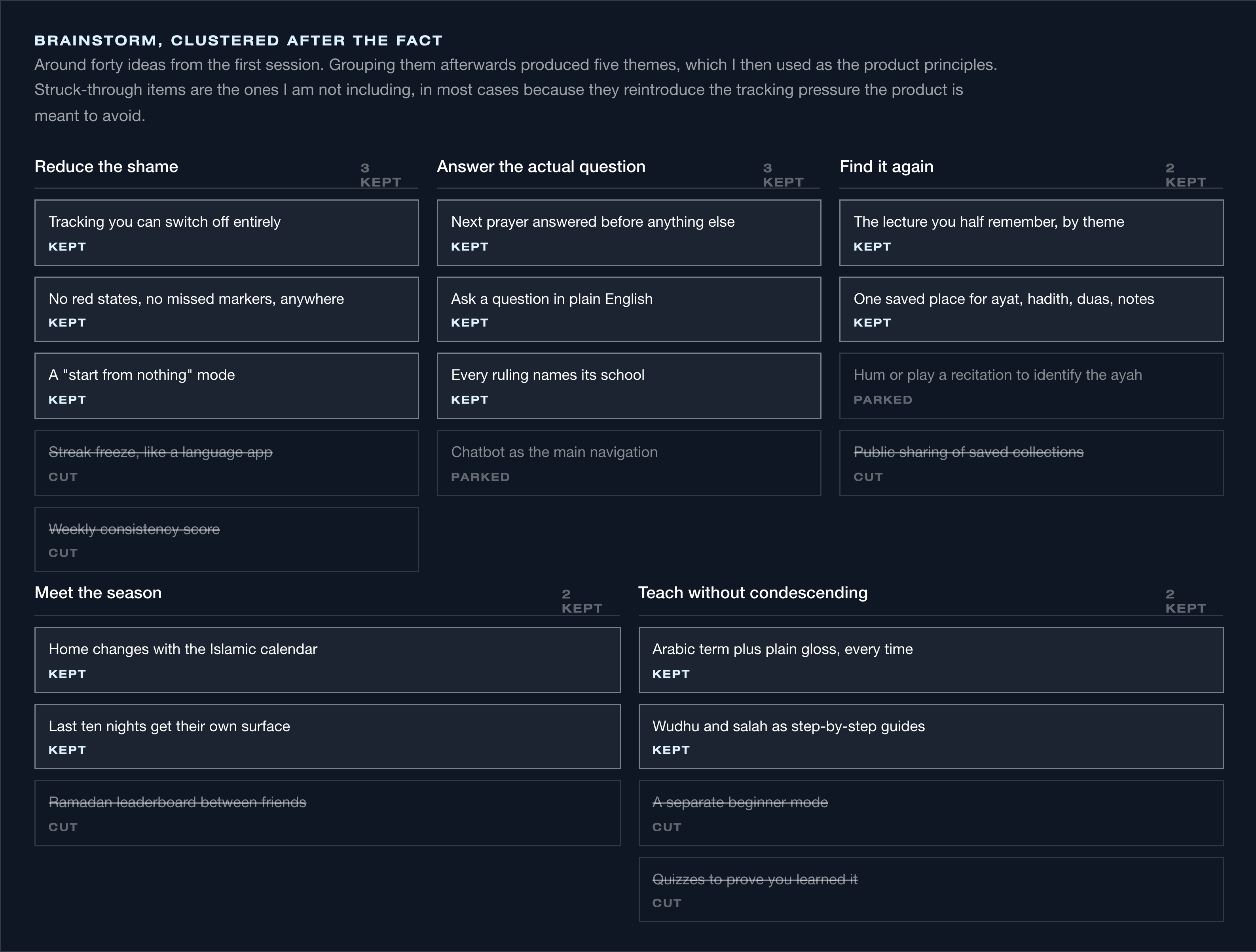
Before the high fidelity system, I externalised the problem space: competitor patterns, audience hypotheses, paper sketches and clustered ideas. The aim was not to make the process look tidy after the fact. It was to make the assumptions visible enough to challenge and to show which ideas were kept, parked or cut.
Journey and architecture
The flow follows confidence, not a streak.
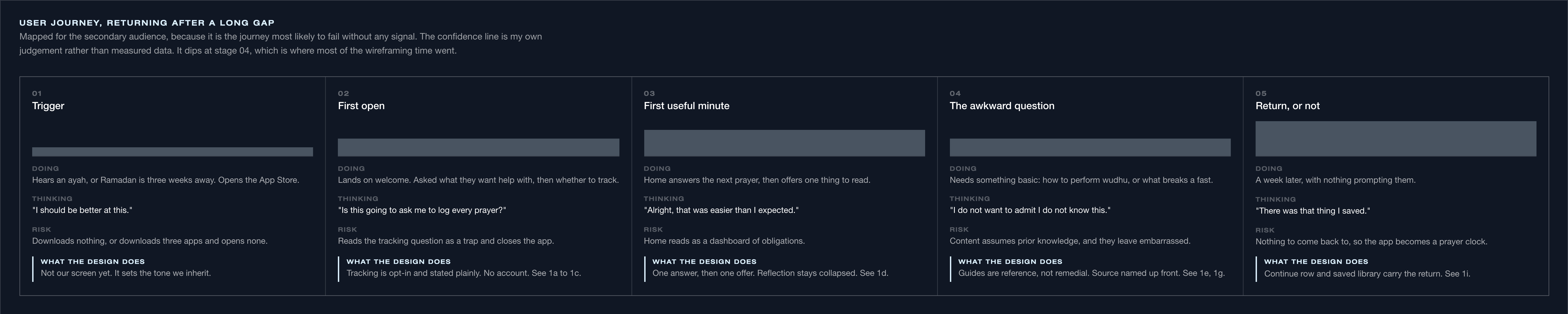
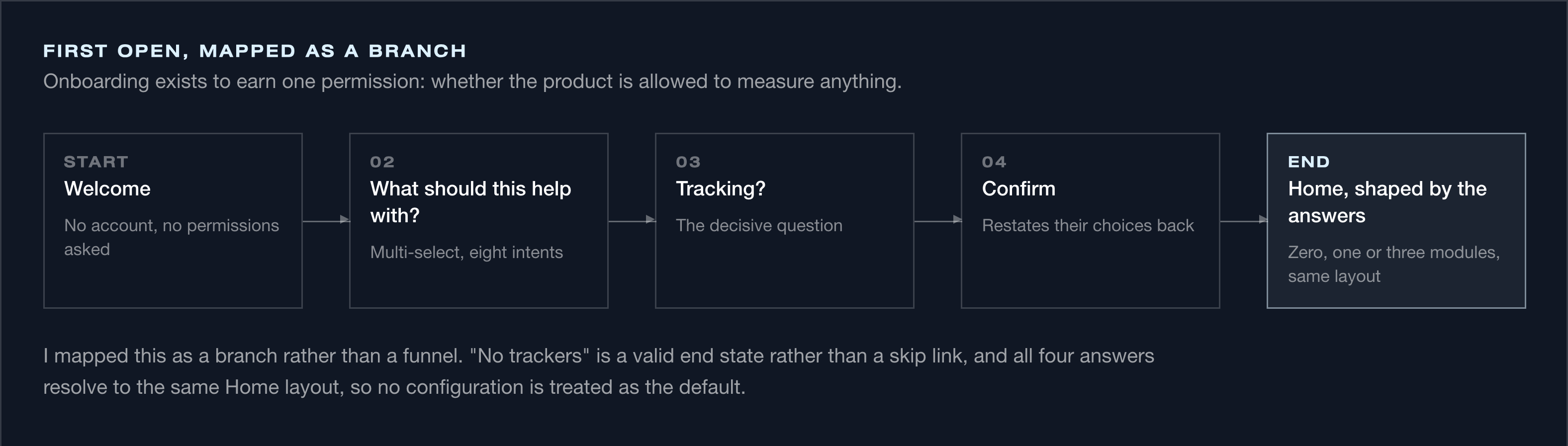
I mapped a returning user's journey from the emotional trigger through first open, first useful minute, an awkward basic question and the decision to return. The confidence line is a design judgement rather than research data, but it helped expose where shame, commitment fear and information density could make the experience fail.
Low fidelity wireframes
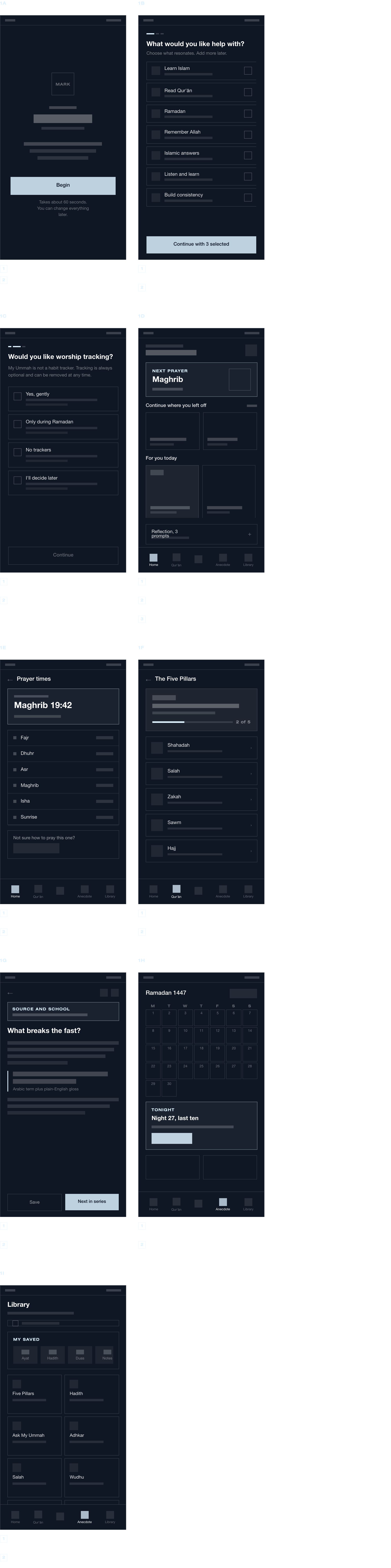
Nine greybox screens before the visual system.
The wireframes forced the hierarchy to work without relying on colour, polish or illustration. I annotated the decisions that mattered most: no compulsory sign up, intent selection in the user's language, equal weight for the no tracking option, prayer context first on Home, visible provenance and a flat library designed for retrieval.
Impact mapping
I mapped the outcome before the feature.
The impact map keeps the feature ecosystem tied to an outcome. The theory of change is that trustworthy context and calmer navigation should make useful guidance easier to reach; easier access should support understanding and return; and that value should be possible without increasing guilt, surveillance or performative engagement. Those outcomes would need qualitative as well as behavioural evidence.
Product principles
Five rules shaped the experience.
Compassionate neutrality.Worship is not productivity. Tracking can be gentle, Ramadan only or completely absent.
Depth without overwhelm.The prototype contains 29 connected screens, but Home only surfaces what is relevant right now.
Editorial, not database dump.Content should feel curated and human, with a reason for being on the screen rather than endless undifferentiated information.
Honest about complexity.Hadith grades, fiqh methodology, source visibility and scholarly disagreement remain visible instead of being flattened into one answer.
Design as respect.Warm dark surfaces, editorial type and generous spacing communicate that Islamic digital products deserve the same design care as premium consumer apps.
Core journeys
What should bring someone back to My Ummah?
I journey mapped different entry moments rather than designing around a single daily streak: preparing for prayer, hearing an ayah, looking up a hadith, saving a lecture, returning to Ramadan planning or needing a basic explanation without embarrassment. The map helped decide what belongs on Home and what should stay deeper in the system.
First open.Choose what My Ummah should help with, choose a tracking preference, then land on immediate value without being forced to create an account.
Daily Ramadan use.Check the next prayer, open morning adhkar, notice Last Ten context, add a personal dua and use a quiet dhikr counter before sleep.
Curiosity led learning.Ask My Ummah a question, inspect Qur'an and source context, then move into deeper learning such as Five Pillars or comparative religion.
New Muslim learning.Find How to Pray, realise wudhu is needed, complete the illustrated guide and return to a step by step Fajr learning flow.
Product architecture
A contextual Home with deeper tools underneath.
The navigation stays deliberately simple: Home, Qur'an, a central Qur'an recognition microphone, Anecdote and Library. Power features live deeper in the system rather than competing for attention on the first screen.
Home
Next prayer, Islamic calendar context, Qur'an continuity, personalised For You content, reflection and conditional Ramadan or tracking modules.
Qur'an
Reader, saved ayat, audio, timeline of revelation, historical context and AI assisted verse identification from recitation.
Anecdote
A personal lecture and podcast library organised by theme, with saved content, speakers, notes and related learning.
Library
Five Pillars, Hadith, Ask My Ummah, Adhkar, Salah, Wudhu, Ruqya, Ramadan, Last Ten, Dhikr, My Dua List, saved content and notes.
MoSCoW helped protect the product from its own ambition. Trusted source visibility, Qur’an access, prayer context, privacy and a usable experience with tracking turned off are Musts. Richer learning and saved content are Shoulds. AI assistance and more adaptive personalisation stay behind evidence, governance and trust rather than becoming launch requirements.
MoSCoW helped decide what earns its place.
For My Ummah, prioritisation is less about fitting in every useful Islamic feature and more about protecting trust. Source visibility, privacy, accessibility and a calm experience have to win when they compete with breadth, novelty or personalisation.
Trusted source visibility, Qur’an access, clear search boundaries, core prayer and learning guidance, privacy controls and a usable experience with worship tracking disabled.
Anecdote, Ramadan context, saved content, wudhu and salah guidance, personal duas and deeper source context.
Comparative religion, verse recognition, richer widgets, advanced Hajj and Zakah tools, and broader personalisation once the core proposition is validated.
Public worship scores, streak pressure, community ranking, unsourced AI rulings or feature breadth that makes Home feel like a dashboard of religious obligation.
Feature ecosystem
Learning, practice and reflection in one system.
Read, recognise and understand
Continuous Arabic and English reading, bookmarks, font control, historical revelation timeline and a microphone flow for identifying an ayah being recited.
Search with provenance
Hadith search keeps collection and grade visible. Ask My Ummah provides sourced educational answers with fiqh context and a clear boundary around personal rulings.
Keep the lecture that stayed with you
Theme based lecture and podcast collections make Islamic audio easier to rediscover than a generic saved list across Spotify, YouTube and notes.
Guidance without scoring
Prayer times, wudhu, How to Pray, adhkar, dhikr and Ruqya are designed as reference and guided learning tools rather than performance dashboards.
Seasonal depth when it matters
Daily planning, fasting calendar, reflection, Last Ten Nights, Laylatul Qadr and a personal dua list build on the structure of the original planner.
Foundations beyond surface level
Shahadah, Salah, Zakah, Sawm and Hajj become expandable learning and planning areas without presenting the pillars as badges to complete.
Context without evangelising
Islam, Christianity and Judaism can be explored side by side across concepts such as God, prophets, scripture, worship and the afterlife with respectful framing.
Useful at the right moment
Prayer, dhikr, Ramadan and Last Ten widget concepts support glanceable use, while Home changes with Islamic calendar context rather than showing every feature all year.
Trust, tone and privacy
Religious information needs a higher design standard.
Sources stay visible
Qur'an, hadith, fiqh, scholarly opinion and AI explanation should never look like interchangeable content types. Provenance remains visible at the point of use.
Warm, not prescriptive
The interface prefers language such as “You might want to…” and “Some scholars hold…” rather than pretending every question has one context free answer.
Spiritual data is sensitive
Prayer tracking, missed fasts, duas, notes and questions require local first thinking, clear deletion controls and a valid experience with no worship tracking at all.
Accessibility
WCAG 2.2 AA is the floor, not the personality.
The visual calm only matters if the service is also operable and understandable. I would design and test keyboard access, visible focus, screen reader structure, contrast, text resizing, meaningful labels, error recovery and alternatives for audio or visual only content.
Arabic and English structure.Reading order, language attributes and labels need to remain clear when Arabic, transliteration and translation appear together.
Audio alternatives.Recitation, lectures and microphone based recognition need transcripts, text equivalents or an alternative path where appropriate.
Cognitive load.Progressive disclosure, predictable navigation and optional tracking help users who can be overwhelmed by dense information or repeated prompts.
No colour only meaning.Prayer state, source type, saved state and warnings need text or structural cues as well as visual styling.
Assumption mapping
I wrote down what would prove me wrong.
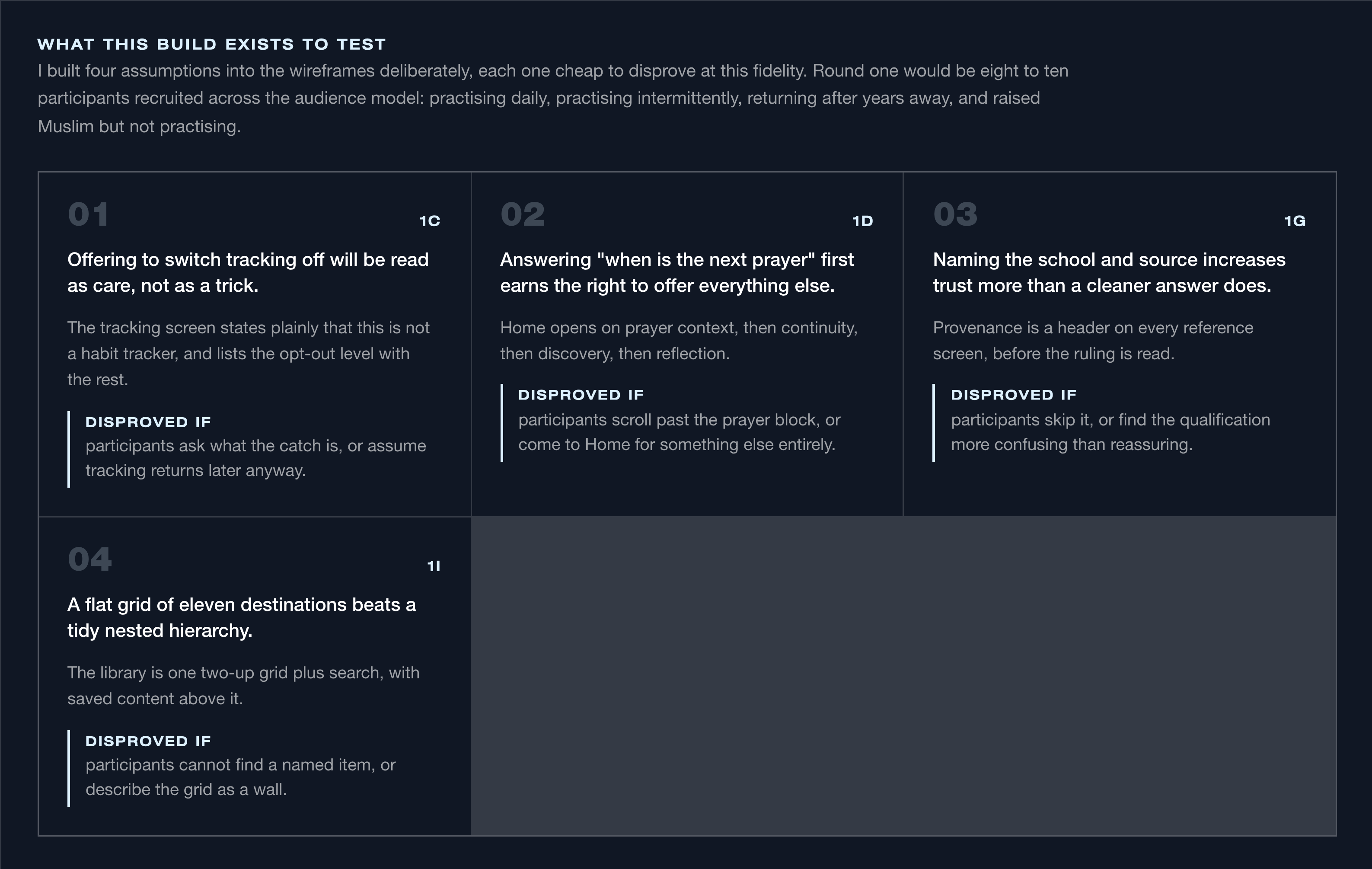
Four assumptions carry disproportionate risk: whether an explicit tracking opt out reads as care, whether prayer context deserves the first position on Home, whether visible scholarly provenance increases trust, and whether a flat library is easier to navigate than a nested hierarchy. Each one has a concrete disproof condition so research can change the design rather than merely endorse it.
Validation plan
What I would test before treating the concept as a solution.
The high fidelity prototype is a design hypothesis. The next step is validating whether the architecture, trust model and emotional tone actually work for the people it is intended to serve.
Discovery
12 to 15 interviews across converts, long term practitioners, diaspora Muslims and younger users, alongside a competitor and content audit.
Task testing
Find a Laylatul Qadr dua, identify a Qur'an verse, disable tracking, find a hadith and determine whether users understand source and fiqh cues.
Navigation
Test whether the Screens access pattern and Five Pillars hub match real mental models or simply make sense to the designer.
Secondary audience
Run a dedicated round with new and reconnecting Muslims to test whether language feels clear, non judgemental and genuinely usable without prior knowledge.
Proposed Beta and Live path
A realistic product would need design, engineering and scholar review in parallel.
Before Beta I would build a service blueprint spanning the visible product, content operations, scholar review, source metadata, search or AI retrieval, moderation, privacy and support. In this product the backstage service is part of the user experience because trust depends on where an answer came from and who is accountable for it.
This is a proposed roadmap rather than a claim that each research and delivery phase has already taken place.
Discovery and research
User interviews, competitor review, authoritative content audit, v1 scope and the beginning of an advisory relationship with scholar reviewers.
Focus: problem confidence and content risk.Strategy and architecture
Navigation, tracking boundaries, end to end flows, content briefs and the Five Pillars architecture are defined before visual expansion.
Focus: make the system understandable before making it beautiful.Design system and product design
Core navigation, Qur'an, Ramadan, worship and knowledge screens are designed using shared tokens, components and editorial rules.
Focus: coherence across 29 connected screens.Prototype and test
High fidelity interactive prototype, first usability round, navigation iteration and a second round with new and reconnecting Muslims.
Current concept stage: interactive prototype.Production and beta
Native iOS build, offline content, APIs, widgets, AI guardrails, scholar review and a closed beta before App Store submission.
Estimated path to launch: roughly 11 to 14 months with a small cross functional team.Post launch learning
Measure navigation, content errors and retention, then consider later scope such as deeper Zakah calculation, Hajj trip mode, moderated community features and Android.
Focus: learn before expanding the surface area.Technical direction
The prototype proves interaction. Production would require a different level of rigour.
Current prototype.React 19, TypeScript and Tailwind CSS v4 support the high fidelity connected concept.
Production direction.Swift and SwiftUI would better support native prayer timing, widgets, background behaviour and iOS performance.
Offline first content.Core Qur'an text, adhkar, wudhu and prayer guidance should remain useful without a network connection, with prayer times cached ahead.
Integration risk.Prayer times, Qur'an text, hadith data, verse recognition and AI all require careful API, licensing, reliability and scholar review decisions.
Product challenge
The risk is not a shortage of ideas. It is protecting the calm.
Biggest product riskFeature breadth could recreate the very overwhelm My Ummah is meant to remove.
The strongest next step is testing which small combination of Home, Qur'an, trusted search, Anecdote and contextual guidance creates enough value to justify the wider ecosystem.
SearchSuccessful retrieval
AnecdoteSave to rediscovery
Qur'anReturn to reading
SourcesOpened and understood
RamadanUseful return use
I would prioritise meaningful Islamic resource interactions over worship quantity. Success is helping someone find, understand, prepare, reflect or return to something useful, not maximising taps.
Interactive prototype
Try My Ummah.
Explore the working concept directly below. The prototype is embedded into the case study so the full experience can be tested without leaving the portfolio.